

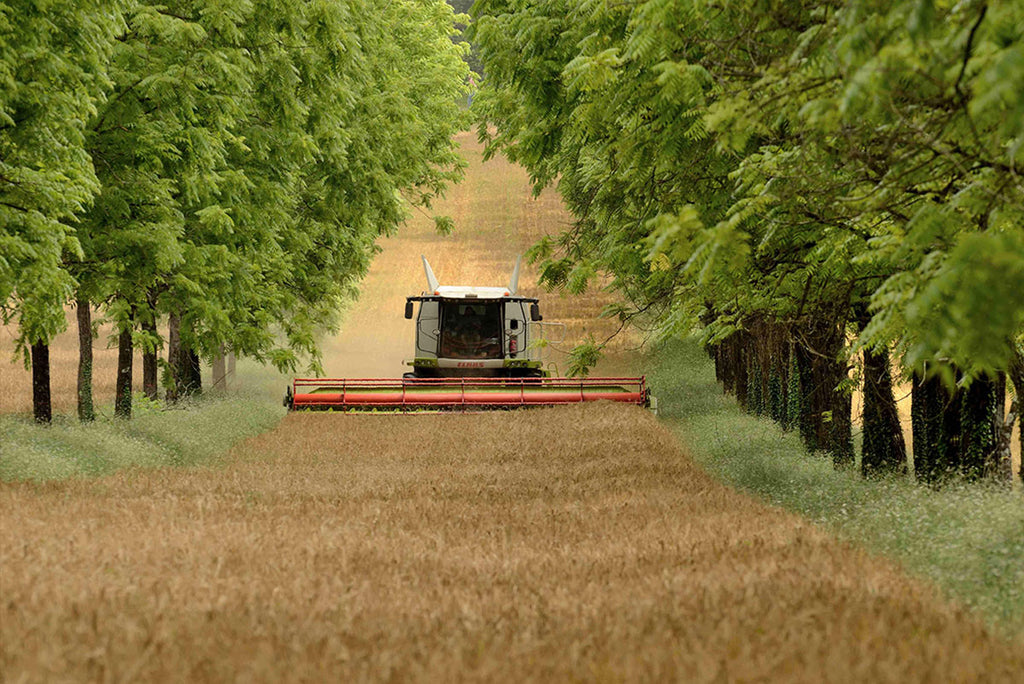


Understorey management, this most seemingly banal topic, really was the focal point of 2025, where considerations of mowing, sheep, tree guards, and financial viability collided in a tumultuous, sweaty summer. It all started with a new 12-acre walnut site secured in January 25 providing, at long last, a place to call our own, a tapestry to weave into reality the seemingly endless ink devoted to the benefits of agroforestry.
The starting point was a pretty generic orchard, managed to suppress ground cover in a neat, herbicide induced lifeless tidiness. Some commentators have rightly pointed out the issue with labelling no-till systems as regenerative, when they often rely on glyphosate to manage under growth. Clearly, the blanket application of this drying, carcinogenic, life-sucking force, couldn’t genuinely be classed as a positive environmental choice. It is however, financially and practically, very appealing. 1 or 2 sprays per year kills off any grass cover, the growth of which does hit yields significantly, particularly for hazelnuts.
Of course, we wanted to change this. Queue a rather arduous learning curve over the Spring and Summer, understanding the limitations of mower types. An exiting tractor flail performed reasonably well but couldn’t get underneath the trees to cut the grass where it really needed. Mowing, or the intention of mowing, had started deliberately late as the carpet of wildflowers showcased the beauty of "no mow May", and a chorus of butterflies throughout the orchard paid testament to the positive effects. But, by July, some neighbourly grumblings and the senescence of the grasses brought the
mowing imperative to a head.
The other option was to hire a suitable sit on, one capable of handling neck high grasses, and fitting under the canopy. Thankfully a very helpful hire company had just the ticket, a diminutive, little powerhouse which chewed through the grasses with comparative ease. Couple of punctures and
a broken steering rod later, and the orchard was complete in 3 days, the best
part of a £1000 lighter.
This sit on dynamo was perfect for shaping the landscape, with partial strips left to grow long further into August, with trimmed swards closer to the trees. We were contending with the understoreys effect on local humidity and the chance this could foster walnut blight, we were fortunate in some respects for the drought, keeping the bacteria high and dry.
But more to the point, was the aesthetic call for a brighter, mosaic, more vital landscape. Why not treat farmland as an aesthetic symbol. Gardening, sculpture, the poetry of natural landscape, we all appreciate; why then concede our productive capacities as mere jobs to do. All art forms come with limitation, so why not see the productive and commercial demands as parameters for the creation of beauty, not justification for relinquishing it.
And so the orchard was left until late August, at which point the needs of shorter ground cover for the forthcoming harvest played keenly on the mind. The clippings need 6 weeks or so to rot down and not interfere with the harvest operation. Sweeping along the floor with rollers or mechanical harvester requires a trim floor cover, when any kind of roughage can play havoc with a smooth collection. Flummoxed at this point by existing equipment and the expense and faff of hiring, the next stop involved contractors, and to my surprise, none in the local area were equipped for orchard work. A striking example of what we often lucidly refer to as “capacity building”; contractors with the kit, skills, and will, to be able to put into action these changes in farming method at a financially viable cost.
This left us with the predicament of a hefty bill for a mowing job that would leave mohican like strips between the trees within the row uncut , as the 8 foot wide topper would only fit down alleys, and not across. Thankfully, Barry was keen on using screwfix’s finest generic lawn mower to finish these missed bits, faithfully marching to it’s keyless din.
All this though, did sit a little uneasy. Why waste time and diesel on a task for which ruminants excel. Grass, grass everywhere, with not a sheep to graze.
That is where we are heading this year; a sizeable fencing investment to divide the orchard into tasty morsels, and an open-minded sheep farmer willing to give it a try. So grazing from June – August, then mowing up
to August through to the harvest. I bit the bullet and purchased the sit on
mower, so we can be much more agile in when and where we mow. More on this come spring time.